
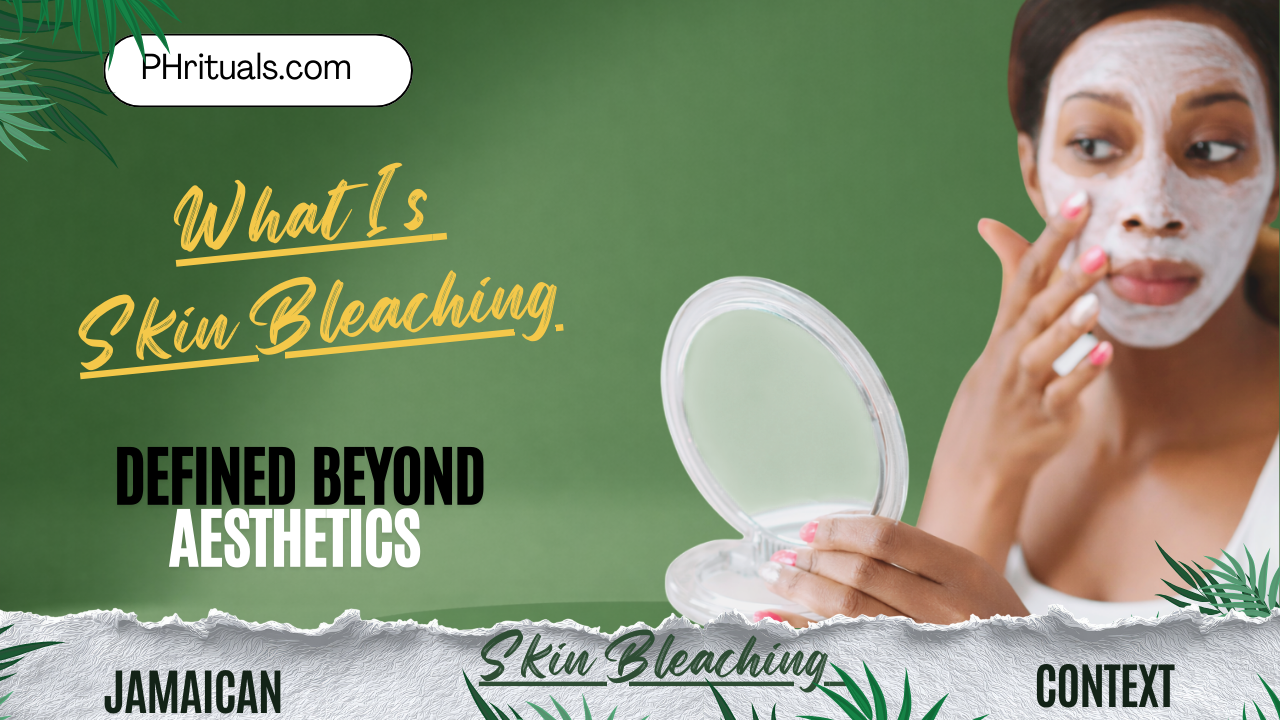
Framing Skin Bleaching Beyond Aesthetics – Skin bleaching—also referred to as skin lightening or skin whitening—is commonly misunderstood as a purely cosmetic practice. In reality, it is a biomedical, sociological, historical, and psychological phenomenon that reflects deeper power structures, racial hierarchies, and postcolonial identity struggles. In Jamaica, skin bleaching cannot be separated from the island’s colonial past, plantation economy, class stratification, media influences, and globalized beauty standards.
While skin bleaching exists across Africa, Asia, the Caribbean, and diaspora communities worldwide, Jamaica presents a distinct case study. The practice here has evolved through multiple historical phases, each reshaping how lighter skin is valued, pursued, regulated, and interpreted.
This article provides a chronological, evidence-based examination of skin bleaching in Jamaica—how it emerged, how it transformed, and how it is currently understood by health authorities, sociologists, and the Jamaican public.
Topic that is highly relevant to this article: How Prevalent Is the Skin Bleaching Phenomenon Globally, and How Does Jamaica Compare?
Defining Skin Bleaching: A Scientific and Public Health Perspective
From a biomedical standpoint, skin bleaching refers to the intentional use of chemical agents or physical methods to reduce melanin concentration in the skin, resulting in a lighter appearance (WHO, 2011).
Common bleaching agents include:
- Hydroquinone
- Mercury salts
- Potent topical corticosteroids
- High-strength acids or unregulated botanical mixtures
Medically, controlled skin lightening may be used for clinical hyperpigmentation disorders (e.g., melasma, post-inflammatory hyperpigmentation). However, cosmetic skin bleaching, as defined by the World Health Organization, occurs outside medical supervision, often using unsafe concentrations and prolonged application (WHO, 2011).
In Jamaica, the term skin bleaching overwhelmingly refers to non-medical cosmetic practices, frequently involving unregulated products sold through informal markets.
Colonial Jamaica (1500s–1838): The Birth of Color Hierarchies
Slavery, Power, and Pigmentation
The origins of skin bleaching in Jamaica are inseparable from European colonialism and transatlantic slavery. Under British rule, skin tone became a proxy for proximity to power.
Colonial Jamaican society operated under a rigid pigmentocracy, where:
- White Europeans held absolute authority
- Mixed-race individuals occupied intermediary social positions
- Dark-skinned Africans were systematically dehumanized
Historical records show that lighter-skinned enslaved people were more likely to receive domestic labor assignments, improved survival conditions, and limited educational access (Beckles, 1999; Higman, 2011).
This created an early psychological association between lighter skin and safety, mobility, and humanity—an association that outlived slavery itself.
Post-Emancipation Jamaica (1838–Early 1900s): Respectability and Assimilation
Colorism After Slavery
Following emancipation in 1838, legal slavery ended—but social stratification based on skin tone persisted. Lighter skin increasingly became linked to:
- Respectability
- Education
- Employment opportunities
- Marriage prospects
Black Jamaicans seeking upward mobility often adopted Eurocentric standards of speech, dress, grooming—and eventually, appearance (Thomas, 2004).
Although commercial bleaching products were not yet widespread, folk practices aimed at skin lightening—such as lemon juice, harsh soaps, and abrasive scrubs—were already circulating through oral tradition (Charles, 2011).
Mid-20th Century (1940s–1970s): Commercialization and Imported Ideals
The Rise of Manufactured Bleaching Products
By the mid-20th century, Jamaica experienced an influx of imported skin lightening creams, many marketed from Europe and later Asia. Products containing mercury and hydroquinone were sold openly, often advertised as enhancing beauty, cleanliness, and refinement (Lewis et al., 2011).
During this period:
- Lighter skin was normalized in advertising
- Dark skin was subtly framed as undesirable or unprofessional
- Skin lightening was marketed primarily to women
This coincided with Jamaica’s push toward modernization and global respectability following independence in 1962.
Late 20th Century (1980s–1990s): Masculinity, Dancehall, and Visibility
A Cultural Shift
The 1980s and 1990s marked a critical transformation in how skin bleaching appeared in Jamaica. Unlike earlier eras, men—particularly within dancehall culture—began bleaching openly.
Research indicates that bleaching during this era was linked to:
- Visibility and notoriety
- Rebellion against middle-class respectability politics
- Shock value within competitive musical spaces (Hope, 2011)
Bleaching became performative, not hidden. It was no longer solely about assimilation but about branding and attention economy.
This marked a significant divergence from earlier motivations rooted in colonial respectability.
Early 2000s: Public Health Crisis and Regulation Attempts
Medical Consequences Become Visible
By the early 2000s, Jamaican dermatologists and public health officials began documenting alarming medical consequences associated with bleaching:
- Exogenous ochronosis
- Skin atrophy
- Chronic infections
- Mercury poisoning
- Adrenal suppression from steroid misuse
Studies conducted in Kingston revealed high prevalence rates, particularly among urban youth (Charles, 2011).
In response, the Jamaican government—through the Ministry of Health and Wellness—introduced regulations restricting mercury-containing products and limiting hydroquinone concentrations (MOHW, 2018).
However, enforcement proved difficult due to informal markets and cross-border imports.
Contemporary Jamaica (2010s–Present): Identity, Trauma, and Contradictions
How Skin Bleaching Is Understood Today
Today, skin bleaching in Jamaica is widely understood through multiple, sometimes conflicting lenses:
- A public health issue
- A psychological response to colorism
- A cultural expression
- A symptom of unresolved colonial trauma
Sociological studies emphasize that modern bleaching is not simply about wanting to be white, but about navigating status, visibility, desirability, and economic precarity (Hope, 2011; Thomas, 2004).
At the same time, public discourse often frames bleachers as irresponsible or deviant—frequently without addressing systemic color bias.
Gender, Class, and Urban Pressure
Who Bleaches—and Why
Recent studies indicate that skin bleaching in Jamaica is:
- More prevalent among urban populations
- Common among individuals aged 15–35
- Influenced by employment discrimination, media imagery, and peer normalization
Men and women bleach for different but overlapping reasons:
- Women often cite beauty, romantic competition, and self-esteem
- Men often cite visibility, intimidation, or performance identity
Importantly, bleaching is not confined to poverty; it appears across socioeconomic strata, though riskier methods are more common among economically marginalized groups (Lewis et al., 2011).
Media, Social Platforms, and Global Reinforcement
Digital Colorism
Contemporary Jamaican bleaching is increasingly reinforced through:
- Instagram and TikTok aesthetics
- Filtered skin tones
- Globalized beauty algorithms
- Influencer culture
These forces repackage colorism into aspirational digital language, often detached from historical accountability.
Medical Consensus: A Practice Without Safe Cosmetic Justification
From a dermatological standpoint, there is no safe justification for cosmetic skin bleaching outside of supervised medical treatment for diagnosed conditions (Dlova et al., 2015).
Health authorities—including the World Health Organization—continue to classify cosmetic bleaching as a global public health concern, particularly in Black and Brown communities (WHO, 2011).
Reframing the Jamaican Conversation
Addressing skin bleaching in Jamaica requires more than prohibition. It requires:
- Historical honesty
- Media accountability
- Mental health integration
- Education rooted in cultural reality—not moral shaming
Until Jamaican society fully confronts colorism as a structural inheritance, skin bleaching will remain a symptom rather than an anomaly.
Conclusion: Definition in the Jamaican Context
In Jamaica, skin bleaching is best defined as a historically inherited, socially reinforced, medically dangerous practice rooted in colonial color hierarchies and sustained by modern economic, cultural, and media pressures.
It is not simply a beauty choice.
It is a legacy behavior—one that reveals how deeply the past still lives in the skin.
References
Beckles, H. (1999). Centering woman: Gender discourses in Caribbean slave society. Princeton University Press.
Charles, C. A. D. (2011). Skin bleaching and the prestige complexion of sexuality in Jamaica. Sexuality & Culture, 15(4), 375–390.
Dlova, N. C., et al. (2015). Skin lightening practices: An overview of prevalence, health consequences, and public health responses. International Journal of Dermatology, 54(1), 1–6.
Higman, B. W. (2011). A concise history of the Caribbean. Cambridge University Press.
Hope, D. P. (2011). Man vibes: Masculinities in the Jamaican dancehall. Ian Randle Publishers.
Lewis, K. M., Robkin, N., Gaska, K., & Njoki, L. C. (2011). Investigating motivations for women’s skin bleaching in Tanzania. Psychology of Women Quarterly, 35(1), 29–37.
Ministry of Health and Wellness. (2018). Regulation of skin bleaching products in Jamaica. Government of Jamaica.
Thomas, D. A. (2004). Modern blackness: Nationalism, globalization, and the politics of culture in Jamaica. Duke University Press.
World Health Organization. (2011). Mercury in skin lightening products. WHO Press.
World Health Organization. (2019). Preventing disease through healthy environments. WHO Press.
Additional supporting sources available upon request.