
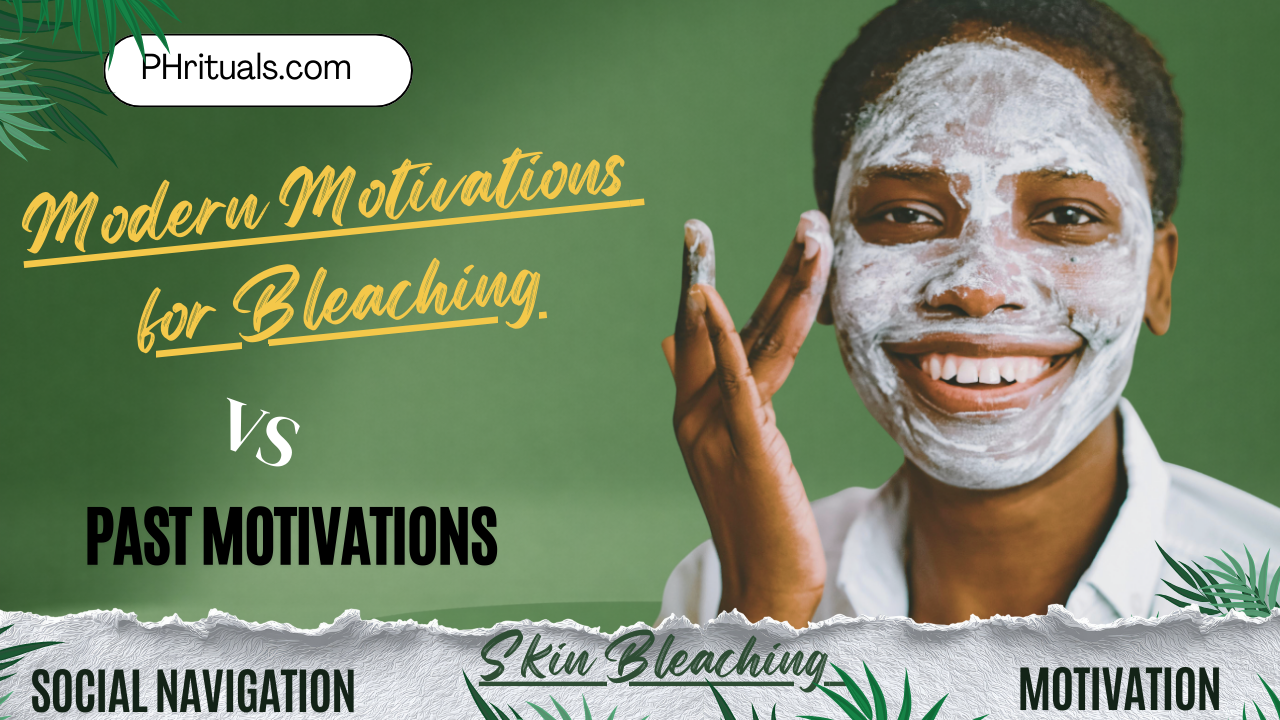
Why Motivation Must Be Examined Across Time
Skin bleaching in Jamaica has not been driven by a single, static motivation. While the practice is often discussed as if its meaning has remained unchanged, historical and social analysis reveals that the reasons people bleach have shifted alongside changes in social structure, visibility, and opportunity.
Understanding these shifts is essential for avoiding oversimplified explanations that collapse past and present motivations into one narrative.
Greater Depth – Structural Continuity:
What Role Does Colorism Play in the Continuation of Skin Bleaching Practices in Jamaican Society?
(Explains the enduring valuation system that makes different motivations possible across time.)
Past Motivations: Survival, Respectability, and Social Navigation
Historically, motivations associated with skin lightening in Jamaica were closely tied to survival within rigid social hierarchies. In colonial and immediate post-emancipation contexts, lighter skin could influence:
- access to less physically brutal labor,
- acceptance within churches or schools,
- perceived moral character and discipline,
- and proximity to social protection.
Within these constraints, appearance management—including attempts to appear “brighter” or “cleaner”—functioned as a risk-mitigation strategy, not a lifestyle choice. Motivation was often implicit rather than openly articulated, embedded in norms of grooming and respectability rather than explicit desire to alter identity.
In this context, skin tone management was less about visibility and more about reducing social penalty.
The Shift From Structural Constraint to Symbolic Opportunity
As Jamaica transitioned further into the post-colonial era, the rigid constraints that once governed opportunity began to loosen, though they did not disappear. Education expanded, legal equality increased, and overt racial hierarchies lost formal legitimacy.
With this shift came a transformation in motivation. Skin bleaching increasingly moved from being a quiet adaptive behavior to a symbolic act—one that could signal aspiration, distinction, or belonging in a changing social landscape.
Motivation began to move away from survival toward self-positioning.
Modern Motivations: Visibility, Performance, and Social Signaling
In contemporary Jamaica, many motivations for skin bleaching are tied to visibility rather than concealment. Bleached skin is often intentionally noticeable, even when uneven or contested.
Modern motivations frequently include:
- attracting attention within peer networks,
- aligning with specific aesthetic subcultures,
- signaling confidence, rebellion, or distinction,
- negotiating desirability in romantic or social markets.
These motivations are shaped by a media-saturated environment in which appearance is constantly evaluated, shared, and commented upon.
Skin bleaching, in this context, functions less as a shield and more as a signal.
From Respectability to Recognition
A key distinction between past and present motivations lies in the shift from respectability to recognition.
- Earlier motivations emphasized fitting into established norms to avoid exclusion.
- Contemporary motivations often emphasize standing out, being noticed, or asserting presence.
This does not mean that respectability has vanished; rather, it now coexists with new forms of social recognition driven by peer culture, popular media, and digital visibility.
The Role of Youth Culture and Social Acceleration
Younger Jamaicans, particularly in urban environments, experience intensified social acceleration—rapid cycles of trend adoption, identity experimentation, and aesthetic differentiation.
Within this environment:
- skin bleaching can be temporary or episodic,
- motivations may shift across life stages,
- and practices may be adopted for specific moments rather than permanently.
This fluidity marks a significant departure from earlier periods, when appearance management was more stable and norm-oriented.
Gendered Shifts in Motivation
Gender continues to shape motivation, but the nature of that influence has evolved.
Historically:
- women faced pressures tied to marriageability and respectability,
- men encountered fewer explicit appearance demands.
In contemporary contexts:
- both men and women navigate visibility, desirability, and status signaling,
- though expectations and consequences differ by gender.
These shifts complicate simplistic narratives that frame bleaching as exclusively feminine or rooted solely in insecurity.
Economic Aspirations and Informal Opportunity Structures
While formal discrimination has declined, informal opportunity structures—particularly in entertainment, nightlife, and service economies—continue to reward appearance in uneven ways.
For some, skin bleaching is motivated by the perception that it enhances:
- marketability,
- employability in appearance-oriented spaces,
- or social capital within specific networks.
Importantly, these motivations are context-specific, not universal, and they fluctuate as social conditions change.
Continuity Without Sameness
Although motivations have shifted, they have not emerged in isolation. Modern motivations draw from the same underlying valuation system described in earlier child articles, even as they express themselves differently.
This explains why contemporary bleaching can appear contradictory—simultaneously critiqued and embraced, stigmatized and celebrated.
Preparing the Transition: From Motivation to Self-Reported Reasons
Understanding motivational shifts provides a structural explanation, but it does not capture how individuals themselves explain their actions.
The next step is to examine what Jamaicans say about why they bleach—without assuming that self-reported reasons are either exhaustive or deceptive.
Lived Explanation: What Are the Most Common Reasons Jamaicans Report for Bleaching Their Skin?
(Examines self-reported motivations without collapsing them into theory.)
Conclusion: Motivation as a Moving Target
Skin bleaching in Jamaica has never been driven by a single motivation. What has changed over time is not the presence of valuation attached to skin tone, but how individuals respond to it.
Past motivations emphasized survival and respectability within rigid hierarchies. Modern motivations emphasize visibility, signaling, and social navigation within accelerated cultural spaces.
Recognizing this shift allows for more precise analysis—and prevents the mistake of treating contemporary practices as replicas of historical ones.
References
Charles, C. A. D. (2011). Skin bleaching and the prestige complexion of sexuality in Jamaica. Sexuality & Culture, 15(4), 375–390.
Glenn, E. N. (2008). Yearning for lightness: Transnational circuits in the marketing and consumption of skin lighteners. Gender & Society, 22(3), 281–302.
Hope, D. P. (2011). Man vibes: Masculinities in the Jamaican dancehall. Ian Randle Publishers.
Hunter, M. L. (2011). Buying racial capital: Skin bleaching and cosmetic surgery in a globalized world. Journal of Pan African Studies, 4(4), 142–164.
Lewis, K. M., Robkin, N., Gaska, K., & Njoki, L. C. (2011). Investigating motivations for women’s skin bleaching. Psychology of Women Quarterly, 35(1), 29–37.
Pierre, M. R. (2008). The predilection for skin bleaching in the Caribbean. Caribbean Journal of Psychology, 2(2), 1–12.
Thomas, D. A. (2004). Modern blackness: Nationalism, globalization, and the politics of culture in Jamaica. Duke University Press.
World Health Organization. (2011). Mercury in skin lightening products. WHO Press.
World Health Organization. (2019). Preventing disease through healthy environments. WHO Press.