
Should I Use Different Products for My Neck and Chest? Learn how to treat these often-neglected areas with the right skincare strategy. Tailored for both tropical Caribbean and international routines, backed by science and tradition.
Skincare Isn’t Just About the Face: Why the Neck and Chest Deserve More Attention
While most skincare routines focus solely on the face, the neck and chest (collectively referred to as the décolletage) often show signs of aging, sun damage, and skin thinning even earlier than the face. These areas are exposed daily yet frequently excluded from sun protection and moisturization.
The question is—should they be treated the same as the face, or do they require different care? The answer lies in understanding how the skin in these zones differs, and how products interact with those differences.
Anatomical Differences: Why One Size Doesn’t Fit All
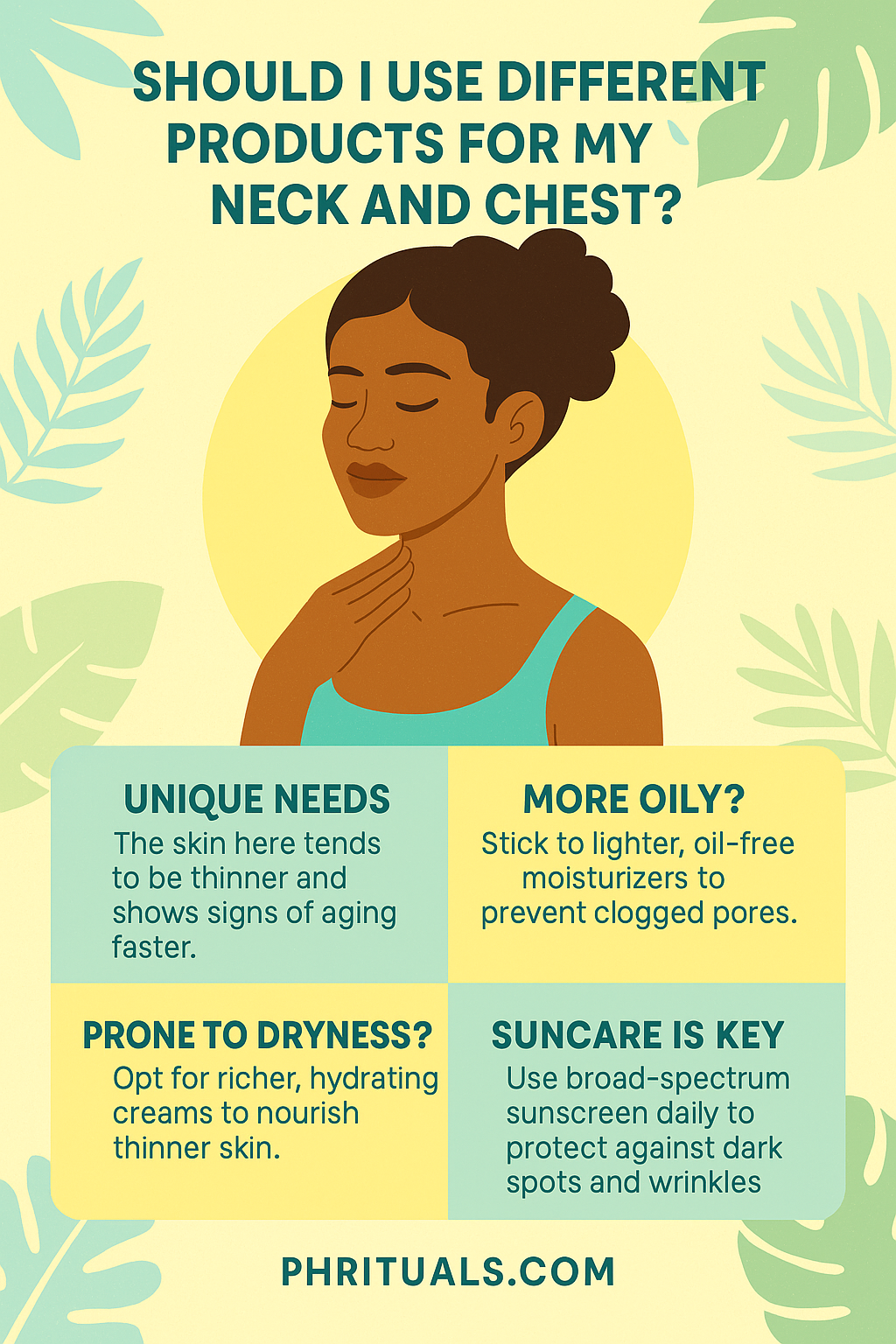
Research shows that the skin on the neck and chest is thinner than facial skin and contains fewer sebaceous (oil) glands (Pugliese, 2001). As a result:
- It is more prone to dryness, crepiness, and sagging.
- It has less collagen density, making it more vulnerable to sun-induced wrinkling.
- It may react more sensitively to active ingredients like retinoids or strong exfoliants.
In warmer regions like the Caribbean, sun exposure and heat-related inflammation further accelerate aging on the neck and chest, particularly without adequate SPF or antioxidant protection.
Can You Use the Same Products for Face, Neck, and Chest?
Yes—and no. Some facial products may be safe and beneficial for the neck and chest, but others might be too potent or insufficient depending on the formulation.
Here’s a breakdown:
| Product Type | Safe to Extend? | Adjustments Needed |
|---|---|---|
| Gentle Cleansers | ✅ Yes | Use upward motions to cleanse neck |
| Hydrating Serums (e.g., hyaluronic acid) | ✅ Yes | Apply while skin is damp |
| Strong Actives (e.g., retinoids, AHAs) | ⚠️ Use caution | Reduce frequency to 2–3x/week |
| SPF | ✅ Absolutely | Apply daily on all exposed areas |
| Rich Moisturizers | ✅ Yes | Choose products with ceramides or peptides |
Tip: If your facial moisturizer is designed for oily skin, it may not provide enough nourishment for the neck or chest, which often lean drier.
Choosing the Right Ingredients for Your Neck and Chest
To maintain skin tone, firmness, and hydration in the neck and chest, consider these clinically supported ingredients:
- Peptides – Encourage collagen synthesis and improve firmness (Watson et al., 2014).
- Niacinamide – Reduces hyperpigmentation and improves barrier function.
- Squalane & Ceramides – Hydrate and repair the lipid barrier, ideal for dry zones.
- Vitamin C – Neutralizes free radicals and brightens sun-exposed skin.
- Broad-Spectrum Sunscreen (SPF 30+) – Essential to prevent UV-induced thinning and discoloration.
Regional Considerations: Caribbean vs. Cooler Climates
In the Caribbean:
- Use lightweight, breathable textures (gels, emulsions) during the day.
- Opt for mineral sunscreens with added antioxidants (e.g., green tea, licorice).
- Apply cooling products like aloe vera or rosewater sprays after sun exposure.
In Cooler/Dryer Climates:
- Use richer creams at night with emollients like shea butter or marula oil.
- Consider overnight masks 2–3 times a week.
- Avoid alcohol-based products that strip natural moisture.
Layering Tips: How to Build a Décolletage Routine
- Cleanse gently with a low-pH cleanser.
- Apply a hydrating toner or mist to prep the skin.
- Use a serum targeted for brightening or firming (e.g., niacinamide + peptides).
- Moisturize generously, using more product than you might for the face.
- Finish with SPF in the daytime, and a nourishing oil or barrier cream at night.
Always apply skincare products in upward strokes from the chest to the chin to promote circulation and combat gravitational sagging.
Final Insight: Treat Your Neck and Chest Like an Extension of Your Face
The skin on your neck and chest may be an afterthought—but it’s often one of the first areas to show signs of age and neglect. While you don’t always need entirely separate products, you do need to adjust how you use them, based on thickness, texture, climate, and skin goals.
By investing a few extra minutes each day—and selecting ingredients that nourish this delicate skin—you’ll keep your décolletage firm, even-toned, and radiant well into the future.
References
Pugliese, P. T. (2001). The physiology of the skin. Allured Publishing Corporation.
Watson, R. E. B., Gibbs, N. K., Griffiths, C. E. M., & Sherratt, M. J. (2014). Damage to skin extracellular matrix induced by UV exposure. Antioxidants & Redox Signaling, 21(7), 1063–1077.