
What Skincare Changes Should I Make in My 40s? Your 40s call for a skincare reset. Discover the key changes your skin needs—from deeper hydration to collagen-boosting actives—designed for melanin-rich and maturing skin in both tropical and temperate climates.
The 40s: A Turning Point in Skin Biology
By your 40s, collagen and elastin levels drop significantly—as much as 25% compared to your 30s. Skin renewal slows down, fat pads begin to shift, and hydration levels decrease. Combined with decades of UV exposure, this decade often brings:
- More pronounced wrinkles
- Loss of firmness, especially around the eyes and jawline
- Increased dryness
- Dull, uneven skin tone
- Sunspots or melasma, particularly in melanin-rich skin
Caribbean populations may experience these signs uniquely due to UV exposure, humidity, and pigment density—requiring specialized, intentional care.
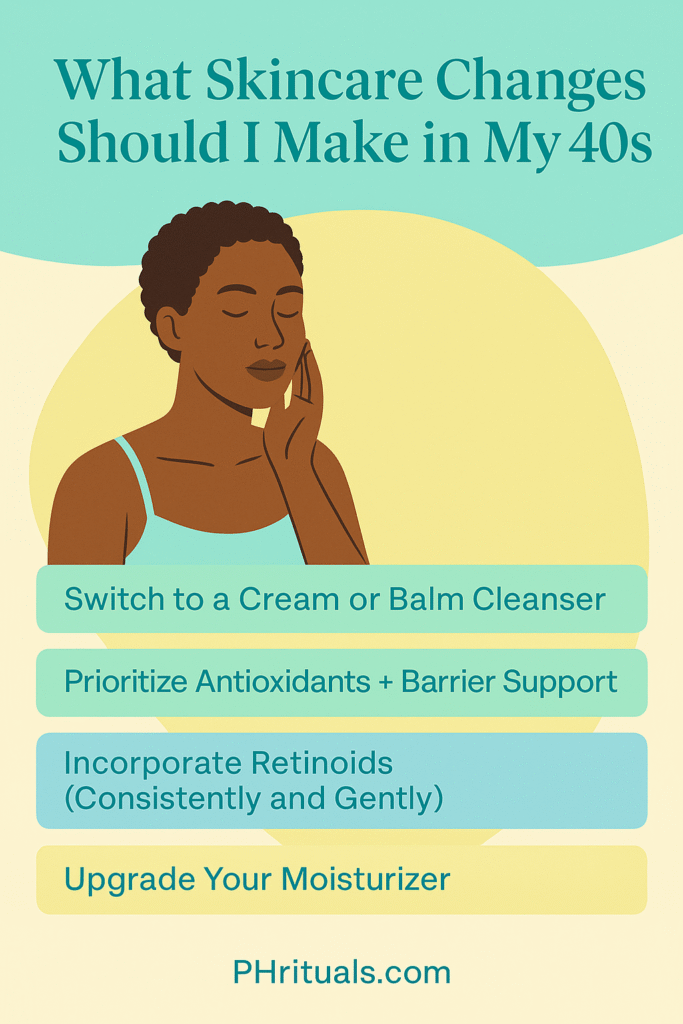
Key Skincare Shifts to Make in Your 40s
1. Switch to a Cream or Balm Cleanser
Foaming cleansers may strip away natural oils. In your 40s, choose gentle, creamy cleansers that support your skin barrier.
Cleansers with ceramides, oat extract, or gentle oils are best for maintaining moisture.
2. Prioritize Antioxidants + Barrier Support
Vitamin C remains important, but now you should add co-antioxidants like Vitamin E and resveratrol for deeper protection (Lin et al., 2005). Combine these with niacinamide for both brightening and barrier repair.
Use local Caribbean botanicals like tamarind and hibiscus for added antioxidant benefits.
3. Use Peptides and Growth Factors
Peptides signal the skin to produce more collagen and improve elasticity (Watson et al., 2017). Products with palmitoyl pentapeptide or Matrixyl can improve the appearance of fine lines and sagging.
Look for peptide eye creams targeting crow’s feet and under-eye puffiness.
4. Incorporate Retinoids (Consistently and Gently)
Retinol helps to stimulate collagen, reduce wrinkles, and promote smoother texture. If you haven’t started yet, now is the time—begin with a low concentration and buffer with moisturizer.
For sensitive skin or first-timers, try bakuchiol—plant-based and less irritating.
5. Upgrade Your Moisturizer
Opt for a rich cream that contains:
- Hyaluronic acid (hydration)
- Ceramides (barrier repair)
- Squalane or shea butter (emollient protection)
Use morning and night—especially if you’re in an air-conditioned or windy environment, which accelerates water loss.
6. Exfoliate Smarter, Not Harder
Dead skin cell turnover slows in your 40s, so gentle chemical exfoliation (like lactic acid or polyhydroxy acids) can brighten and smooth without irritation.
| Skin Type | Recommended Exfoliant |
|---|---|
| Sensitive | Lactic acid or PHAs |
| Oily/Combination | Salicylic acid (BHA) |
| Dry | Mandelic acid or enzyme peels |
7. Don’t Skimp on Sunscreen—Boost It
Your skin’s repair response weakens with age, so daily sunscreen becomes even more critical. Use broad-spectrum SPF 30+, and consider formulas with added antioxidants.
Reapply every 2 hours if outdoors, especially in the Caribbean where UV index is consistently high.
Add-Ons That Make a Difference
- Facial oils (e.g., rosehip, moringa) after moisturizer to seal in hydration
- Eye masks and night creams with caffeine or peptides
- Microneedling or Gua Sha to boost circulation and product absorption
- Weekly hydration masks for a plumping effect
Internal Care: The Skin–Body Connection
Nutrition
Increase intake of:
- Vitamin A (sweet potatoes, carrots)
- Vitamin C (guava, oranges)
- Omega-3s (chia seeds, flax, avocado)
Herbal teas like cerasee or lemongrass also support detoxification and inflammation control.
Sleep & Stress
Sleep loss and chronic stress speed up aging via cortisol dysregulation. Prioritize 7–8 hours nightly and engage in rituals like:
- Deep breathing
- Yoga or stretching
- Magnesium supplementation
A Routine Framework for 40s Skin
| Step | Morning | Evening |
|---|---|---|
| Cleanse | Cream cleanser | Cream or oil-based cleanser |
| Treat | Vitamin C, peptides | Retinol or bakuchiol |
| Hydrate | HA + ceramide moisturizer | Ceramide or night cream + facial oil |
| Protect (AM only) | Broad-spectrum SPF 30+ | — |
| Bonus (2–3x/week) | Exfoliation / hydration masks | Gua sha, facial massage, or night treatments |
Caribbean-Specific Adjustments
- Choose products in airless packaging to protect ingredients from heat/humidity
- Store actives (like Vitamin C or retinol) in cool, dry spaces
- Layer hydrating serums under sunscreen on especially hot days
- Consider locally sourced botanicals—like sorrel or soursop extract—for added antioxidant support
When to See a Dermatologist
If you experience:
- Rapid pigmentation or melasma
- Sudden onset sagging or texture changes
- Hormonal acne or rosacea symptoms
A professional can customize treatments such as chemical peels, laser therapy, or prescription-strength retinoids.
Final Word: Your 40s Are About Fortifying
Skincare in your 40s is less about reversing damage and more about fortifying your foundation. It’s about preserving radiance, increasing resilience, and celebrating the wisdom your skin carries. With the right knowledge and ingredients, your glow doesn’t fade—it evolves.
At PHrituals, we honor every stage of your skin’s journey—with science, with soul, and with culture.
Sources
- Lin, F. H., Lin, J. Y., Gupta, R. D., Tournas, J. A., Burch, J. A., Selim, M. A., … & Pinnell, S. R. (2005). Ferulic acid stabilizes a solution of vitamins C and E and doubles its photoprotection of skin. Journal of Investigative Dermatology, 125(4), 826–832.
- Mukherjee, S., Date, A., Patravale, V., Korting, H. C., Roeder, A., & Weindl, G. (2006). Retinoids in the treatment of skin aging: An overview of clinical efficacy and safety. Clinical Interventions in Aging, 1(4), 327–348.
- Watson, R. E. B., Gibbs, N. K., Griffiths, C. E. M., & Sherratt, M. J. (2017). Damage to skin extracellular matrix induced by UV exposure. Antioxidants & Redox Signaling, 21(7), 1063–1077.